Programming
Math in the Mountains blends deep mathematical exploration with hands-on discovery, outdoor experience, and community learning. Our programming is designed to help students engage with mathematics as an exploratory, creative, and collaborative discipline — not just a collection of topics, but a way of thinking.
Alpha, Omega, Beta, Winter Camps
form a developmental pathway:
exploration → deeper study → creation → action
Alpha Camp: A Starting Point for Mathematical Exploration
Alpha Camp is the foundation of the MitM experience. It introduces students to the culture of mathematical exploration through rich, non-standard topics, discussion-based sessions, and hands-on activities that invite curiosity and sustained engagement.
Students who love Alpha often find themselves drawn into questions like:
Number theory via computation & coding
The visual beauty of complex numbers
Topology of surfaces & knot theory
Calculus of skiing
Math games in non-Euclidean spaces
Probability & infinite series
Unsolved math problems
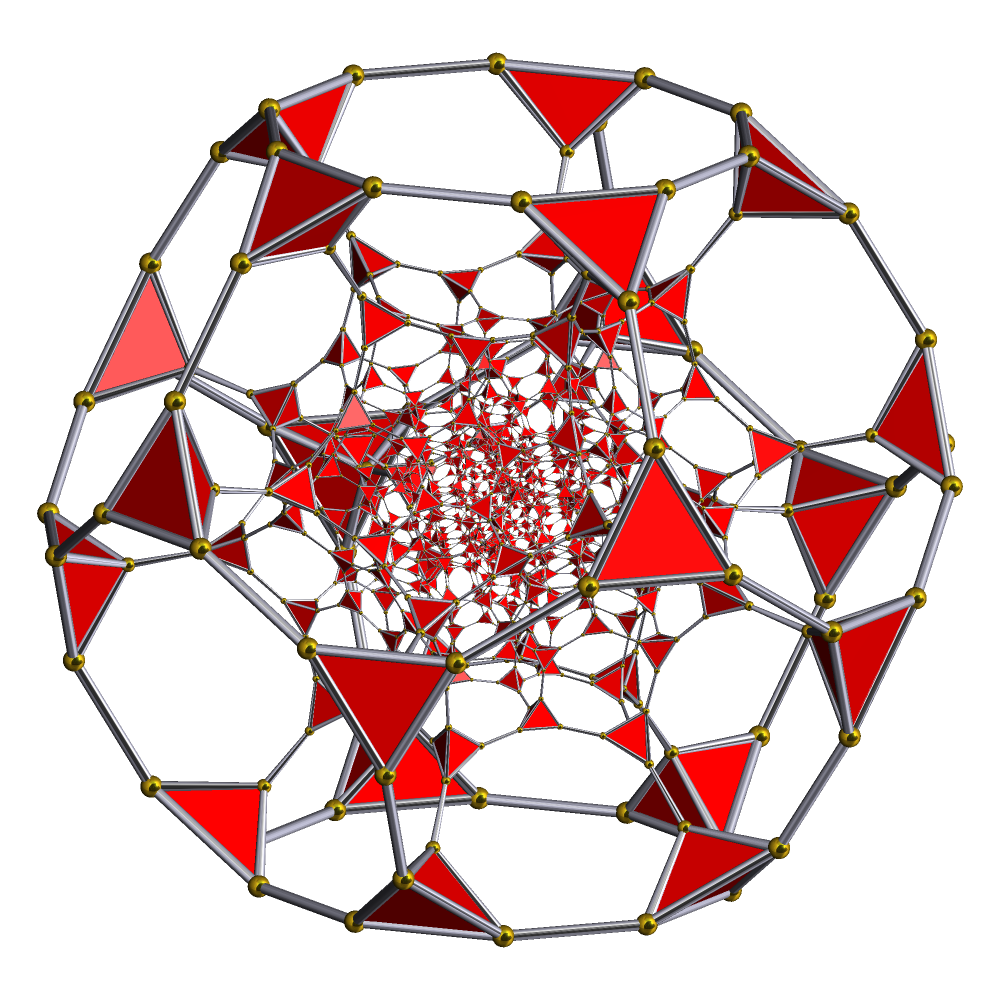
In a given morning, students may explore Fibonacci divisibility patterns by hand, by theory, and using Python. Later, they might investigate questions like: How many ways can we color the edges of a dodecahedron using three colors? In the afternoon, they may tie regular heptagonal knots with paper strips, build three-dimensional shadows of four-dimensional polytopes, or use topology and parity to perform surprising “math magic.”
Alpha sets the tone for MitM: mathematics as exploration, play, creativity, and deep thinking.
Omega Camp: Advanced Study & Mentorship
Omega is an advanced residential experience for returning MitM campers who are ready for deeper research-oriented mathematical study, increased independence, and highly personalized faculty attention. It extends the MitM model through more targeted coursework, small-group instruction, and sustained engagement with challenging ideas.
Omega campers participate in a blend of shared classes with the broader MitM community and smaller, more focused sessions designed for this experienced cohort. Faculty consult with students in advance to understand their interests and help shape specialized coursework.
A hallmark of Omega is the Oxford-style tutorial model, in which students work closely with a faculty member — sometimes in very small groups, or even one-on-one — on a topic chosen in consultation with the instructor. Campers immerse themselves in a single area of mathematics over the course of the week and present their work to the community at the end of camp. Past topics have included the Riemann Hypothesis, Narayana Numbers, Dirichlet’s Theorem, and mathematical art with Python.
Omega also features a distinct set of outdoor experiences in a smaller-group setting, which may include camping, mountaineering, via ferrata, and cycling. The program serves as a bridge toward longer residential mathematics programs for middle and high school students, while remaining rooted in the MitM culture of exploration and collaboration.
Beta Camp: Mathematical Venture Creation & Innovation
Beta is a pilot program for our most experienced MitM campers that builds on the organic collaborations and idea-sharing already emerging within the MitM community. Designed as a collaborative venture-creation experience grounded in mathematical thinking, Beta gives students the opportunity to take intellectual ownership and explore how mathematical ideas can lead to new projects, initiatives, and forms of impact.
Working in small teams with close faculty mentorship, campers identify questions or challenges they care about and investigate how mathematical tools, patterns, and ways of thinking can help address them. The emphasis is on creativity, initiative, and sustained exploration — extending beyond traditional problem sets into designing and developing new ideas.
Many Beta projects will focus on mathematics education itself. For example, one idea already emerging from the MitM community explores how MitM’s place-based approach to math learning might be adapted to engage students from the broader community, helping cultivate a deeper love for mathematics at scale. Other projects may take different directions, but all are rooted in mathematical thinking and collaborative creation.
Winter Camp: Mathematical Exploration in Motion
Winter Camp brings together mathematics and mountain adventure in partnership with Teton Science Schools (TSS) and Jackson Hole Mountain Resort (JHMR). Families experience the same MitM blend of intellectual exploration and outdoor challenge — this time on snow. Winter Camp 2025 took place during a deep powder cycle and marked the first time a ski-meets-math program was designed in tandem by such a distinguished group of partners.
Residential options are available at the TSS campus. Camper skiers are grouped by ability (beginner, intermediate, expert), with professional ski instructors arranged for each group. Parents may ski in separate groups or choose to participate in other activities — skiing is encouraged but not required.
Mornings and afternoons are spent on the mountain, while math talks and activities weave naturally through the day. Students have explored topics like the Calculus of Skiing and Chairlift Combinatorics— learning in ski boots in a JHMR conference room before heading back out onto the snow.
Winter Camp preserves the MitM rhythm: shared learning, outdoor challenge, and an intellectual community that continues long after the lifts close. It offers a seasonal expression of the MitM philosophy — mathematics explored through movement, environment, and shared experience.
Community Learning
Learning at MitM happens not only in classes, but across the entire student and family community, and in conversation with the broader Teton Valley community, where public plenaries and events invite local participation.
Faculty offer plenary talks that bring everyone together to share big ideas, mathematical stories, and connections to research and the wider world. Campers also have opportunities to present their own explorations, building confidence and learning from one another. Mathematics grows through conversation, and MitM is designed to create space for that exchange across ages and roles.
Parents are an important part of the community as well. They may observe sessions, join faculty talks, and participate in discussions about supporting their children’s mathematical growth. MitM is built on the belief that mathematics grows best in conversation — across ages, roles, and perspectives.
Faculty Plenaries
Faculty members have offered memorable plenaries to our entire community.
Paul Zeitz has shared perspectives on today’s math curriculum and creative approaches to teaching bright and gifted students, alongside stories from his own path as a U.S. Math Olympiad winner, coach of the first U.S. team to ever earn a perfect score on the IMO, and founder of Proof School.
Ken Ono has introduced campers to cutting-edge number theory — including a new theorem (on prime-number generating functions) he shared with MitM students before publication — and discussed the life of Ramanujan through his work on The Man Who Knew Infinity.
Po-Shen Loh has lectured on probability and combinatorics atop Rendezvous Peak at 10,450 feet, and explored how to thrive in a changing educational landscape shaped by AI.
Lauren Williams has shared her work on triangulations in physics and nature, connecting ideas from algebra, combinatorics, and geometry to patterns that appear across the natural and scientific world.
James Tanton has presented his celebrated “Exploding Dots,” connecting number bases to polynomial division.
Ed Seidel has explored the intersection of mathematics, quantum computing, and Einsteinian physics.
Andrew Chung has spoken about the broader ways mathematical thinking shapes fields from graph theory and combinatorics to genomics, venture capital, and entrepreneurial decision-making.
These plenaries model for students how mathematics connects to research, education, creativity, and real-world thinking — and how mathematicians themselves remain explorers.
Student & Parent Sharing
Campers may also share some of their favorite explorations from their own mathematical journeys with the group during camp — from Level 3 Menger Sponges to patterns in Pascal’s Triangle and beyond.
Parents participate in parallel community discussions focused on supporting their children’s love for mathematics. These sessions emphasize shared learning within a small but vibrant community. Topics have included:
How You Support Your Child’s Love for Math – extracurricular math, online courses, mentors, summer options
Philosophy of Parenting Gifted Children
Math Explorations by Campers
Applying a Mathematical Mindset to other Subjects and Activities